
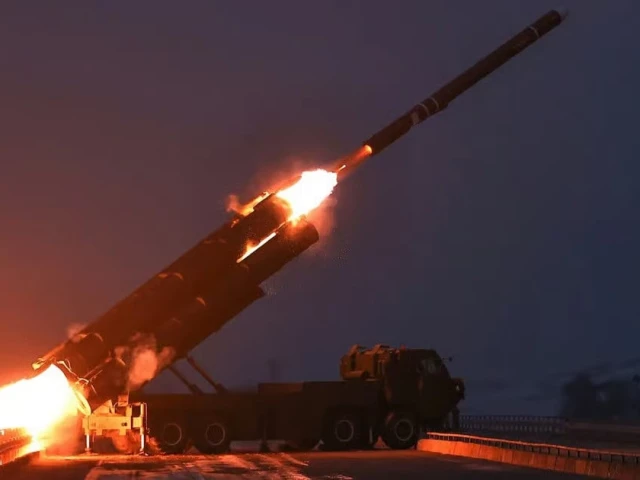

North Korea fired multiple ballistic missiles off its east coast on Sunday, marking its first missile test of 2026, according to South Korea’s military. The launch took place just hours before South Korean President Lee Jae Myung departed for China for a high-level summit, adding to regional and global tensions.
South Korea’s defence ministry said it detected “several projectiles, presumed to be ballistic missiles,” launched from an area near Pyongyang at approximately 7:50 am local time. The military confirmed it has raised surveillance levels and remains on high alert in case of further launches. More visits to my website pakistan breaking news.
Seoul and Tokyo Respond
Following the launch, South Korea stated that its armed forces had strengthened monitoring and coordination with allies. Japan’s defence ministry also confirmed it detected a possible ballistic missile, which reportedly landed at an unspecified location around 8:08 am.
Japanese officials said they are analysing flight data to determine the missile type and trajectory. No immediate damage or casualties were reported, but the launch has triggered renewed security concerns across Northeast Asia.
First Launch Since November
Sunday’s test was North Korea’s first ballistic missile launch since November, when it carried out a weapons test shortly after US President Donald Trump approved South Korea’s plan to develop a nuclear-powered submarine. That decision had already strained relations between Washington and Pyongyang.
The timing of the latest launch has drawn particular attention, as it comes amid heightened global tensions following recent US military actions in Latin America.
Link to US Military Action in Venezuela
Analysts believe the missile test may be connected to Washington’s recent military operation against Venezuela, which resulted in the arrest of Venezuelan President Nicolas Maduro. For North Korea’s leadership, such an operation represents a long-standing fear scenario — the forceful removal of a foreign leader by the United States.
One regional security analyst suggested the launch was intended as a warning. North Korea has repeatedly argued that its missile and nuclear programmes exist solely to deter what it describes as US-led regime change efforts.
“They likely fear that if the United States chooses, it could launch a precision strike at any moment, threatening the regime’s survival,” said Hong Min of the Korea Institute for National Unification. “The underlying message is that attacking North Korea would not be as simple as a strike on Venezuela.”
Pyongyang’s Deterrence Narrative
For decades, Pyongyang has framed its weapons development as a defensive necessity. North Korean officials argue that their missile programme is essential to protect the country from external threats, particularly from the United States and its regional allies.
Washington has consistently denied having plans to overthrow North Korea’s government and has stated that it remains open to dialogue. Despite these assurances, Pyongyang continues to view US military actions abroad as evidence that such promises cannot be trusted.
Diplomatic Timing Raises Concerns
The missile test occurred only hours before South Korea’s president left for Beijing to meet Chinese President Xi Jinping. China is North Korea’s most important economic and political supporter, and the timing of the launch risks complicating regional diplomacy.
Analysts say Pyongyang may be attempting to influence discussions between Seoul and Beijing by reminding both sides of North Korea’s military capabilities. Any escalation on the Korean Peninsula could also put pressure on China, which has repeatedly called for stability and restraint.
Regional Security on Edge
The launch has reinforced concerns about security in East Asia, where military activity has increased in recent years. South Korea and Japan continue to strengthen missile defence systems, while the United States maintains a significant military presence in the region.
Although no immediate escalation followed Sunday’s launch, defence officials warned that further tests cannot be ruled out. Previous missile launches by North Korea have often been followed by additional demonstrations of force.
What Happens Next?
Experts say the coming weeks will be critical. If North Korea conducts additional tests, it could trigger stronger responses from the United States and its allies. Diplomatic efforts may also become more complicated as global attention remains divided between conflicts in multiple regions.
For now, South Korea’s military says it remains fully prepared, while Japan and the United States continue to share intelligence. Whether Pyongyang is signalling deterrence, protest, or preparation for negotiations remains unclear.