
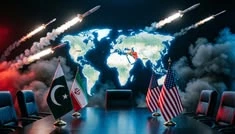
Iran After Khamenei: How the IRGC Seized Power and Hardened Tehran’s War Stance

A Leadership Vacuum at the Worst Possible Time
For over four decades, the Islamic Republic of Iran revolved around a single, undisputed authority — the Supreme Leader. Every major decision on war, diplomacy, economics, and social policy ultimately passed through one desk. That centralised model gave Iran remarkable strategic consistency, even if it came at the cost of political flexibility.
That model collapsed on the first day of the war when Ayatollah Ali Khamenei, along with members of his family including his granddaughter, was killed in the opening strike conducted by Israeli and American forces. The assassination did not just remove a person — it removed the institutional glue holding Iran’s competing power centres together.
His son, Mojtaba Khamenei, survived the strike but was severely wounded — reportedly disfigured and left with serious leg injuries. He has not appeared publicly since and communicates through IRGC intermediaries or limited audio links due to ongoing security concerns. In the weeks that followed, Mojtaba was elevated to the apex of the system, but those familiar with internal deliberations describe his role as one of symbolic assent rather than strategic command.
“We’ve gone from divine power to hard power. From the influence of the clerics to the influence of the Revolutionary Guard Corps. This is how Iran is being governed.”— Aaron David Miller, Former US Negotiator
The IRGC Steps Into the Void
Into the vacuum stepped Iran’s most powerful institutional force: the Islamic Revolutionary Guard Corps. The IRGC was already a dominant player in Iran’s economy, politics, and military before the war began. But the chaos and urgency of wartime governance gave the Guards something they had never quite achieved before — unchallenged supremacy over the entire decision-making apparatus.
Decision-making has now concentrated in a narrow, hardline inner circle anchored in three institutions: the Supreme National Security Council (SNSC), the Supreme Leader’s Office (operating on behalf of Mojtaba), and the IRGC itself. Pragmatists and moderate voices — who had previously served as a counterweight — have been sidelined.
Pakistan, which has been playing a key mediating role in peace talks between Iran and the United States, has offered a telling observation: Iranian responses to proposals take two to three days because there is no single command structure issuing clear decisions. Multiple institutional nodes must arrive at consensus before any answer can be sent.
Who Actually Calls the Shots?
Iran’s public diplomatic face at the US talks has been Foreign Minister Abbas Araghchi, with parliament speaker Mohammed Bagher Ghalibaf — a former Guards commander — emerging as a key political bridge. But on the operational ground level, IRGC commander Ahmad Vahidi has been identified by Pakistani and Iranian sources as the pivotal figure, including during the night a ceasefire was announced.
Hardline figures like former nuclear negotiator Saeed Jalili have raised their public profiles through aggressive wartime rhetoric, but analysts note they lack the institutional weight to dictate outcomes. The Guards remain the ultimate arbiter.
Why Peace Talks Keep Stalling
Understanding who now governs Iran explains a great deal about why negotiations with Washington have ground to a near standstill. The gap between what each side is willing to accept is wide — but the deeper problem is structural.
Iran submitted a proposal to Washington in late April suggesting a staged approach: set the nuclear issue aside initially, resolve disputes over Gulf shipping and the war’s immediate consequences first, and address nuclear matters later. Washington has rejected this framing entirely, insisting that nuclear issues must be on the table from the very first round.
Meanwhile, the IRGC’s institutional culture makes compromise extremely difficult. The Guards see their foundational mission as preserving the Islamic Republic at home while projecting deterrence abroad. Any concession to American pressure — especially on nuclear policy — risks being read internally as weakness, which no IRGC commander can afford.
“Neither side wants to negotiate. Both believe time will weaken the other — Iran through leverage over the Strait of Hormuz, Washington through economic pressure and a blockade. For either side, flexibility would be seen as weakness.”— Alan Eyre, Iran Expert & Former US Diplomat
On the American side, President Trump faces the pressure of midterm elections, which limits the political space available for any deal that could be painted as a concession to Iran. The result is a diplomatic standoff where both parties are structurally incentivised to hold firm even as the costs of continued conflict mount.
What This Power Shift Means for Iran’s Future
Analysts who study Iran’s internal dynamics are drawing a stark conclusion: the country’s leadership is no longer choosing between moderate and hardline policy. The realistic choice, as two Iranian sources close to power circles described it, is between hardline and even harder line.
A strategic consensus has reportedly emerged within the wartime leadership: avoid returning to full-scale open conflict, preserve leverage especially over the Strait of Hormuz, and emerge from the conflict in a stronger political, economic, and military position than Iran entered it.
Driven by revolutionary Islamism and a security-first worldview, the IRGC views centralised control and resistance to Western pressure — particularly on nuclear and regional policy — not as tactical choices but as core ideological commitments. With Iran’s clerical establishment weakened and no civilian actor capable of challenging the Guards, this worldview now shapes every major decision the country makes.
Despite sustained military and economic pressure over nearly nine weeks of war, Iran has shown no signs of internal fracture, mass civilian dissent, or significant elite defections. That cohesion, rather than reassuring outside observers, is itself a sign of how thoroughly the security establishment has consolidated its grip.
A Historic Reordering of Iranian Governance
What is unfolding in Iran is not merely a temporary wartime adjustment — it represents a fundamental reordering of how the Islamic Republic is structured and governed. The shift from clerical primacy to security dominance has been underway for years, but the war has accelerated and institutionalised it in ways that will be very difficult to reverse.
Mojtaba Khamenei may carry the title of Supreme Leader and serve as a convening figure for major decisions, but he is unlikely to overrule the SNSC or the IRGC generals who are actively running the war effort. Important agreements may pass through him for formal blessing, but the substance of those agreements will be shaped by the Guards.
For outside powers attempting to engage Iran — whether Washington, European capitals, or regional mediators like Pakistan — this means they must now reckon with a fundamentally different interlocutor than the one they dealt with in previous years. Agreements that might have been reachable through diplomacy with a pragmatic clerical leadership now face the far harder task of satisfying an institution whose identity is bound up with resistance and strength.
Frequently Asked Questions (FAQs)
Who is currently in charge of Iran after Khamenei’s death?
Mojtaba Khamenei, the late Supreme Leader’s son, has been elevated to the top of Iran’s political hierarchy. However, analysts and insiders describe his role as largely ceremonial — he legitimises decisions made by the IRGC and the Supreme National Security Council rather than directing them himself.
What is the IRGC and why does it now dominate Iran?
The Islamic Revolutionary Guard Corps is Iran’s most powerful military-political institution, responsible for both domestic security and foreign operations. With civilian and clerical leadership weakened by the war, the IRGC has stepped in as the dominant force shaping wartime strategy, political decisions, and diplomatic positioning.
Why are Iran–US peace talks failing?
The core sticking point is nuclear policy. Iran wants to stage talks — resolving the war and shipping disputes first — while Washington insists nuclear issues must be addressed upfront. Beyond the substance, the IRGC’s hardline institutional culture makes concessions on nuclear policy politically toxic inside Iran.
Is there any opposition to IRGC rule inside Iran?
According to analysts and insiders, there is no meaningful internal opposition with the power to challenge the Guards’ dominance. Some voices may argue for even harder positions, but there is no significant moderate or pragmatist faction capable of altering the strategic consensus that has formed around the IRGC.
What does Iran’s IRGC control mean for the Strait of Hormuz?
The IRGC views control over the Strait of Hormuz as one of Iran’s most powerful strategic assets in its standoff with the United States. The wartime leadership has reportedly made preserving Hormuz leverage a central pillar of its strategy, meaning any deal would likely need to address this issue alongside or ahead of nuclear concerns.
Could Iran’s power structure change after the war ends?
Most analysts believe the IRGC’s wartime consolidation of power will be difficult to reverse, regardless of how the conflict ends. The institutional shifts — sidelining of pragmatists, concentration of decision-making in security bodies — tend to persist long after the immediate pressures that produced them have passed.
What role is Pakistan playing in Iran–US negotiations?
Pakistan has been serving as a key mediating channel between Tehran and Washington. Pakistani officials have been briefed on progress (or lack thereof) in the peace talks and have noted that Iran’s complex, multi-node decision-making structure makes responses slow — sometimes taking two to three days — complicating the pace of any negotiations.